Brenda Owns a Small Book Store That Also Serves as an Art Gallery for Her Artwork
By Brenda Milkofsky
In 1492, Christopher Columbus sailed west from Kingdom of spain seeking a water road to the spice markets of India. Instead, after weeks of sailing, he encountered a sea full of islands that he named the West Indies. This big grouping of by and large volcanic islands lies between Florida and the coast of Due south America. As Spain declined in power, other European nations rushed to institute colonies on even the smallest islands. Colonizers hoped to obtain exotic or valuable raw materials for sale in Europe and to open new markets on the islands for European manufactures. England, which began settling the Northward American mainland in 1607, joined her neighbors in planting colonies in this Caribbean Sea of opportunity. Connecticut, along with other New England colonies, slid quickly into the slipstream of British trade and became an important player in a new international system of commercial exchange.
Colonists Brainstorm W Indies Trade
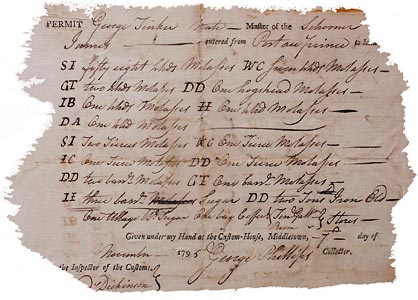
On a Triangle Trade voyage, the schooner James delivered molasses from what is now Haiti to Middletown in 1795 – Connecticut River Museum
By the late 1600s, the beaver and other fur-bearing animals that had been the foundation of Connecticut's trade with England had all but disappeared. Farmers sought markets for their products from field and wood so they could purchase English cloth, tools, and other essential domestic goods. Because farmers all over New England engaged in growing many of the aforementioned crops and raising similar livestock, they needed to find an outlet beyond the region's shores.
In 1649, merchants from Wethersfield and Hartford invested in the edifice of a small vessel, the Tryall, to brand a "trial" of trading with the English island of Barbados, which had been settled in 1627. The Tryall sailed out of the Connecticut River loaded with fresh subcontract produce, lumber, and barrel staves (the vertical wooden slabs that when bound together with hoops form the butt). From this small starting time, a prosperous trade adult between Connecticut and the islands of the West Indies. Customs records indicate that the trade relationships between colonial Connecticut and the populous English language islands of Barbados and St. Kitts were especially strong.
The success of this merchandise between mainland Northward America and the West Indies was based on the introduction of sugar equally the islands' primary crop. Sugar is native to Polynesia and was brought from the Canary Islands to the Westward Indies by Columbus on his 2d voyage. Tobacco and cotton were tried every bit greenbacks crops, but they did not do also as saccharide.
Everybody Wants Carbohydrate
The demand for the sweetener in England and elsewhere was tied to the introduction of tea, coffee, and cocoa—all biting without carbohydrate—to public venues and private houses. The dramatic ascent in saccharide use and the prices it commanded on the market place led island planters to devote their country to sugar pikestaff cultivation instead of growing their own food or raising their own livestock. They cut down forests to plant the canes and erected forts to protect their harbors from foreign powers. This concentration on one ingather meant that the islands had to import much of what they needed past water; New England was non that far away.
Connecticut merchants kept this trade in move. They nerveless "land produce" from outlying farmers at their stores in exchange for imported goods: English cloth, fe, glass, and crockery; Eastward Indian silk, tea, and spices; and West Indian saccharide, molasses, rum, table salt, fruit, and coffee. Local shopkeepers in Connecticut's small towns traded with merchants in the larger cities, such as Hartford, Middletown, New London, Norwich, and New Oasis, or directly with importers in New York or Boston. When they had collected enough produce to make full a vessel they hired a captain and sent a send to islands where they had agents, family members, or friends who assisted in disposing of the cargo and locating enough island products to return home with a total hold.
On October 25, 1795, when the brig Polly & Betsey sailed from the port of Middletown to Jamaica, the two-masted vessel carried a Connecticut cargo typical of the island trade. On board, according to the manifest, at that place were barrels of salted beefiness and pork, shad, and pickled codfish. In that location was cheese, butter, beans, potatoes, corn, onions, and apples. Next listed were barrel staves, hoops, hoop poles, lumber, shingles, and oak planks. The live animals included 314 geese, 40 turkeys, five hogs, and 200 sheep. The Polly& Betsey did not list big animals on the manifest, but every year betwixt 1796 and 1820 an boilerplate of 500 cattle were shipped to the West Indies "alive on deck" from Connecticut River ports. Captains were required to comport enough water for the live animals and hay if they were transporting livestock. Over-burdened vessels, hurricanes, xanthous fever and seizures by foreign flags were perils of the trade.
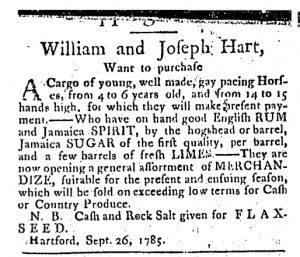
Ad, Connecticut Courant, 1785
The send helm, who generally made two voyages a year, was responsible for the prophylactic of the ship and the crew just also the profitable sale of the cargo. Working for different merchants, a helm would go once afterward the fall harvest and again in the bound after the harbor ice thawed. A voyage took from ii to v weeks depending on the weather condition and port of phone call. Often, the send'south commander had to visit several islands to sell the entire cargo. A assisting voyage depended on unknown market weather, speed of commitment, local contacts, safety passage through oftentimes-fierce storms, fair prices, and reputable products. All of this was accomplished without benefit of sophisticated navigational methods or even expert communication across the news shouted betwixt passing ships.
Vessels for the West Indies trade provided piece of work to sawmills, shipbuilders, sail and rope makers, shipyard workers, and farmers. The latter often supplied not only the cargoes but besides the ship timbers and labor, such every bit hauling. Although a few 3-masted ships were engaged in the trade, smaller vessels were preferred. Vessels in this merchandise ranged from 90 to 150 anxiety on deck. As well big a vessel took weeks to locate adequate return cargo and fully load.
Slaves and Trade
On most every island, the ship captain found vast estates powered past enslaved Africans who produced sugar for export. Huge wooden rollers crushed the canes, and the juice was cooked down to a coarse brown sugar chosen muscavado and its waste matter production, molasses. Island distilleries too fabricated a quality rum that was the source of the planter's profits.
Sometimes slaves were part of the return cargo to Connecticut along with coffee and tropical fruit, but the existent object of the trade was saccharide and molasses for New England's rum distilleries. Of the approximately v,000 slaves in Connecticut at the time of the Revolutionary War, most came to the colony through the W Indies Trade. Between vii and nine meg enslaved Africans were brought in bondage to the Caribbean area offset in most 1530 to work in hot, boiling fields and the unsafe boiling houses where the juice was cooked to crystal.
During the Colonial period, Britain tried to control the Westward Indies merchandise and her mainland colonies. Through the various Navigation Acts, the Molasses Act (1733), and the Sugar Human action (1764), the Crown aimed to prevent trade and smuggling with not-British Islands and enhance acquirement. Some historians debate that the powerful West Indies entrance hall in Parliament, fabricated upwardly of British bankers who held the debt of the planters, was behind the castigating acts.
During the American Revolution, New Englanders raided island forts to seize valuable cannon, pulverization, and shot. Some West Indian assemblies opposed British policy toward their North American colonies for fear that they, in the islands, would starve without the corresponding trade; but none officially joined the fray.
The Terminate of Trade
During the kickoff quarter of the 19th century, a series of events and circumstances brought the West Indies merchandise to a ho-hum, agonizing end. The continued threat and reality of slave rebellions in the islands made for a very loftier cost of maintaining British soldiers there. The debt of island planters to British bankers grew as the productivity of their wearied soil declined. Bankers in England constitute other, more than reliable investments, such as railroads, canals, and the new, steam-powered factories.
In the United States, President Thomas Jefferson ordered the Embargo of 1807, which prohibited Us ships from leaving American ports. The embargo'southward advocates hoped that the measure would aid the United states avoid being drawn into the state of war between Britain and France and likewise prevent the capture of Us vessels. This strategy, withal, caused fiscal ruin for many in maritime communities, including those of Connecticut.
Abolitionist forces in Britain made the slave trade illegal in 1807 and emancipated people held as slaves in British possessions in 1834. Freed people might work every bit freemen on their former plantations, but they also began to grow their own nutrient in corner plots. The infrastructure of the merchandise collapsed, and plantations stopped improving their facilities with imported lumber and no longer feed their at present-freed workforce with imported food. The development of the carbohydrate beet equally an alternative sweetener took many Fundamental European customers out of the market place.
The Spider web of Slavery
The Due west Indies trade was based on captured and enslaved Africans forced to piece of work in agronomical slavery on the carbohydrate islands. Many people in Connecticut profited from this trade, from the ship-owning merchant to the milkmaid who traded her cheese for sugar at the country store. Farmers expanded their cultivated fields and sent their sons to Yale with profits from the trade, and shipbuilding, which became a major industry, used the West Indies trade for enquiry and development.
In 1776, Connecticut served the Continental Army as "the provision state" considering her merchants were experienced at finding and moving farmers' cattle, produce, and other critical supplies over long distances. Agriculture and the maritime trades were the handmaidens of Connecticut's early economy and provided stability so that self-government might also flourish.
Today, much of the country's remaining early architecture survives from this catamenia because quality materials were used by experienced builders and architects to create substantial homes for people who grew wealthy in the trade. Furniture makers, portrait painters, and fifty-fifty clothiers created enduring works of fine art on commissions from these merchants.
Brenda Milkofsky curated the exhibition A Grand Reliance, The Westward Indies Trade in the Connecticut Valley while Director-Curator of the Connecticut River Museum in Essex, CT.
vincentknines1992.blogspot.com
Source: https://connecticuthistory.org/connecticut-and-the-west-indies-trade/
0 Response to "Brenda Owns a Small Book Store That Also Serves as an Art Gallery for Her Artwork"
Post a Comment