Msi Geforce Gtx 1050 Ti Directx 12 Gtx 1050 Review
At a Glance
Practiced'due south Rating
Pros
- Doesn't need actress ability connectors
- Superior performance to its Radeon analogue
- Power efficient, cool, and quiet
Cons
- 2GB of onboard memory isn't very future-proof
- G-Sync monitors cost significantly more than than FreeSync displays
Our Verdict
MSI's overclocked GeForce GTX 1050 graphics carte outpunches its AMD rival for significantly lower cost, and tin can seamlessly skid into prebuilt "big box" computers. Information technology's a great budget gaming selection.
Best Prices Today

$248.88
Later months of focusing on the high cease, Nvidia'due south GeForce GTX 10-series is finally trickling downward to the masses. The $109 GeForce GTX 1050 and its bigger brother, the $139 GeForce GTX 1050 Ti, are a pair of affordable new graphics cards designed to ease introductions into PC gaming.
At those prices, information technology'southward clear that Nvidia's aiming directly at the Radeon RX 460'south jugular—prompting AMD to launch preemptive price cuts. But the GTX 1050 and GTX 1050 Ti are more than fresh foot soldiers in the never-ending war between AMD and Nvidia. While the older GTX 950 required the use of an actress half-dozen-pivot power connector for most of its life, the GTX 1050 and GTX 1050 Ti assume the mantle of the popular GTX 750 Ti by sipping a mere 75 watts of power, assuasive them to draw all needed energy via your motherboard alone. That means you can slap Nvidia'southward new cards into a prebuilt "large box" PC from the likes of HP and Dell to transform them into full-fledged gaming machines with minimal hassle—a fob that 2GB variants of the Radeon RX 460 can also perform.
Tin Nvidia's GeForce GTX 1050 and GTX 1050 Ti degrade their Radeon rival, much less live up to the GTX 750 Ti's immense legacy? Let's dig in.
Meet the GeForce GTX 1050 and GTX 1050 Ti
To add to the intrigue, the GTX 1050 family isn't congenital on the same underlying technology every bit the remainder of Nvidia'due south GTX 10-series. Taiwan Semiconductor Manufacturing Visitor (TSMC) fabricates the GTX 1080, GTX 1070, and GTX 1060 using the 16nm manufacturing process and Nvidia's "Pascal" GPU architecture, but the GTX 1050's brand-new "GP107" graphics processor is built using the 14nm procedure at an undisclosed manufacturer (probable Samsung).
The benchmarks will reveal whether that makes a difference in performance. At first blush, the GTX 1050 and GTX 1050 Ti hit far lower overall clock speeds than the residuum of the GTX ten-series, all of which avowal at least one,500MHz base of operations clocks and boost clocks hovering around 1,700MHz or higher. Past contrast, neither GTX 1050 card achieves 1,500MHz even when boosting, though Nvidia says it was able to "hit speeds in excess of 1,900MHz with ease" when overclocking the cards internally.
Bank check out the $110 GTX 1050 and $140 GTX 1050 Ti's full specs below.
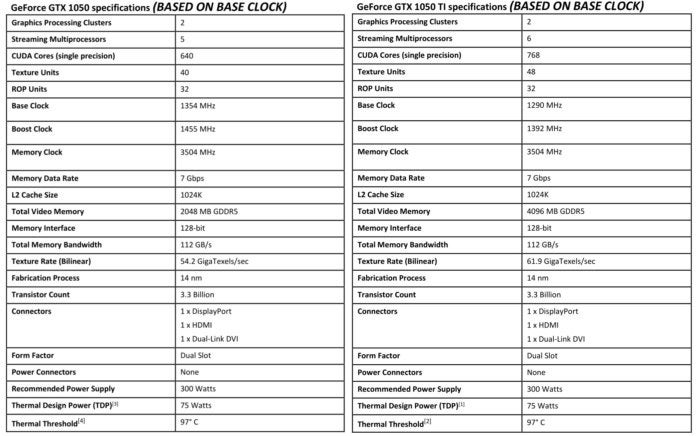
The Nvidia GeForce GTX 1050 and GTX 1050 Ti's total technical specifications. (Click on whatever image in this article to enlarge it.)
AMD'due south $110 Radeon RX 460 and $140 RX 460 differ merely in retentivity capacity—at their heart, the "Polaris" GPU in both versions are the same. Nvidia also uses 2GB (GTX 1050) and 4GB (GTX 1050 Ti) retentiveness capacities to differentiate between its two cards, but each offers different performance levels as well. The pricier GTX 1050 Ti packs the full-fat version of the GP107 GPU, with 768 CUDA cores and 48 texture units beyond its six Pascal streaming multiprocessors. The cheaper GTX 1050 features a college clock speed, simply shaves off a streaming multiprocessor, resulting in 640 CUDA cores and twoscore texture units—exactly half the internal hardware of the $250 GTX 1060.
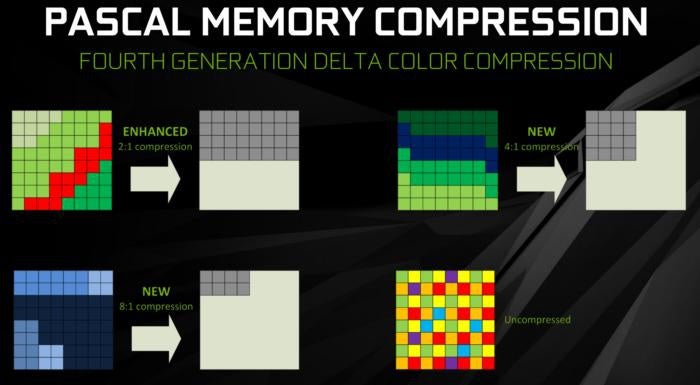
Both cards offering 7Gbps memory speeds over a 128-bit bus, buoyed past Nvidia's superb bandwidth-saving delta color retentiveness compression.
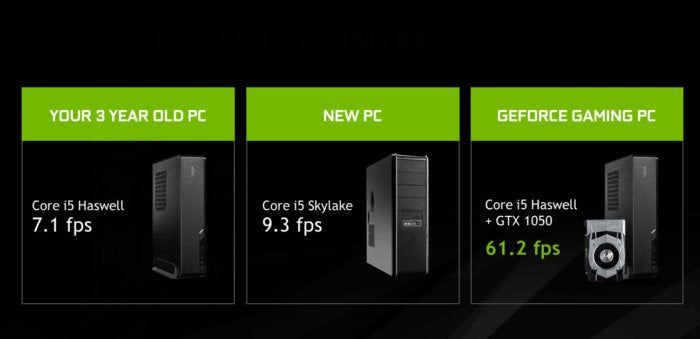
But more importantly, both cards draw under 75W of power, assuasive them to sideslip seamlessly into many prebuilt boxed PCs. The 2GB Radeon RX 460 tin can too, of course, though the majority released at launch bolstered functioning by requiring an additional six-pivot power connect, negating that upgradability advantage. Card makers will be able to add together six-pin ability connectors to customized GTX 1050 and 1050 Ti variants, as well, simply both of the cards tested today describe their full power from a motherboard. Calculation a discrete GPU to a prebuilt PC provides a massive boost in gaming performance, as illustrated in the Nvidia-supplied graphic below.
The GTX 1050 and GTX 1050 Ti offer all the same features as Nvidia's other "Pascal"-based GTX 10-serial cards, including goodies such every bit HDR back up, Ansel super screenshots, Fast Sync, simultaneous multi-projection, performance-boosting multi-resolution shading, and more (again, all of which we covered in detail in PCWorld'south GeForce GTX 1080 review). The default port configuration consists of one DisplayPort 1.four, ane HDMI 2.0, and i DVI-D connector, merely as with the GTX 1060, the GTX 1050 family unit doesn't back up multi-GPU SLI configurations.
Nvidia isn't releasing a Founders Edition version of the GTX 1050 or GTX 1050 Ti, and a wide diversity of custom boards from a wide variety of graphics card makers will be available when the lineup launches Tuesday. Nosotros tested two no-frills, single-fan graphics cards.
 Brad Chacos
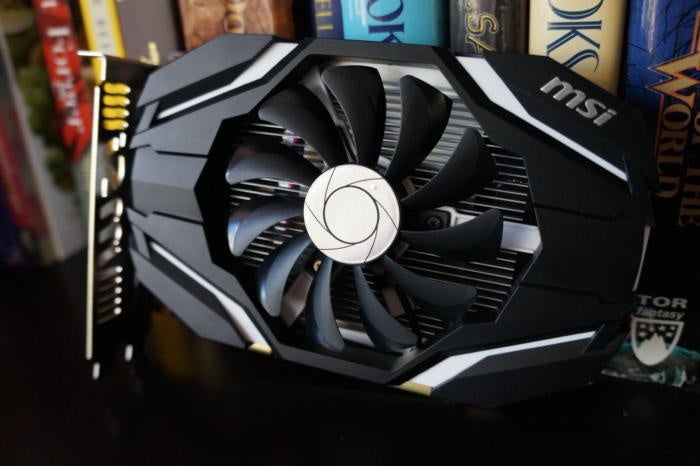
 The $110 MSI GTX 1050 OC.
The MSI GTX 1050 OC with 2GB of RAM adds a roughly 50MHz overclock (to one,404MHz base/1,518MHz boost) without any extra cost. It will be priced at $110 when information technology launches at some point before Nov eight.
 Brad Chacos
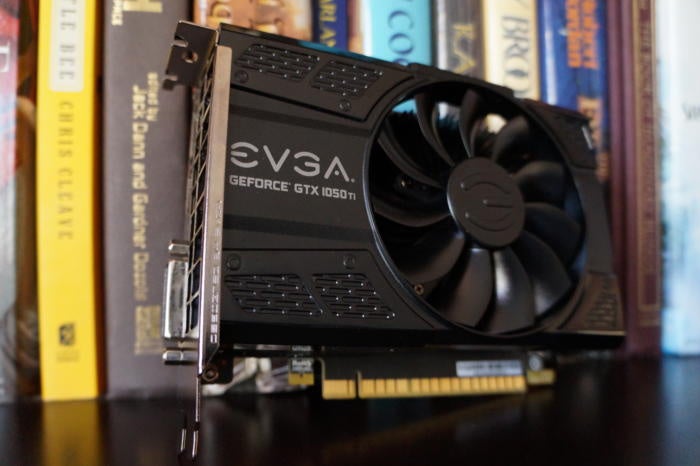
 The $140 EVGA GTX 1050 Ti SC Gaming.
The EVGA GTX 1050 Ti SC Gaming ($150 on Newegg) with 4GB of memory ups things a bit farther over the stock GTX 1050 Ti, to 1,354MHz base/ane,468MHz boost, with the assistance of EVGA's ACX 2.0 cooling engineering.
Nvidia says the GTX 1050 lineup is capable of playing modern games at 60-plus frames per second at 1080p resolution, at either Medium or High graphics settings. Is it truthful? Onto the fun stuff!
Next folio: System configuration, functioning benchmarks
Our test organisation
We tested the MSI GTX 1050 OC and EVGA GTX 1050 SC Gaming on PCWorld's dedicated graphics card benchmark system. Our testbed's loaded with high-end components to avoid bottlenecks in other parts of the organisation and show unfettered graphics functioning. Central highlights:
- Intel'southward Core i7-5960X ($i,000 on Amazon) with a Corsair Hydro Series H100i closed-loop water cooler ($104.twenty on Amazon).
- An Asus X99 Deluxe motherboard ($280 on Amazon).
- Corsair's Vengeance LPX DDR4 retentiveness ($94 on Amazon), Obsidian 750D full-belfry case ($145 on Amazon), and 1,200-watt AX1200i power supply ($310 on Amazon).
- A 480GB Intel 730 series SSD ($245 on Amazon).
- Windows x Pro ($199 on Amazon).
Nosotros're comparing the $110 MSI GTX 1050 OC and $140 EVGA GTX 1050 Ti against Sapphire's $140 4GB Radeon RX 460, XFX's $220 Radeon RX 470 Black Edition, and the GTX 1050's predecessors, the EVGA GTX 750 Ti and EVGA GTX 950 SSC. (Recall, all the same, that the GTX 950 wasn't considered a straight GTX 750 successor like the GTX 1050 is, and demands a six-pin power connector—as does the 4GB RX 460). All of these cards are custom-cooled, overclocked models.
We benchmark every game using the default graphics settings unless otherwise noted, with all vendor-specific special features—such as Nvidia's GameWorks effects, AMD's TressFX, and FreeSync/Yard-Sync—as well as VSync and frame rate caps disabled. Based on the target performance of the GTX 1050 and GTX 1050 Ti, we're looking at 1080p results alone today, including Medium fidelity.
Test 1: The Division
The Division, a gorgeous 3rd-person shooter/RPG that mixes elements ofDestinyandGears of War, kicks things off with Ubisoft's new Snowdrop engine.
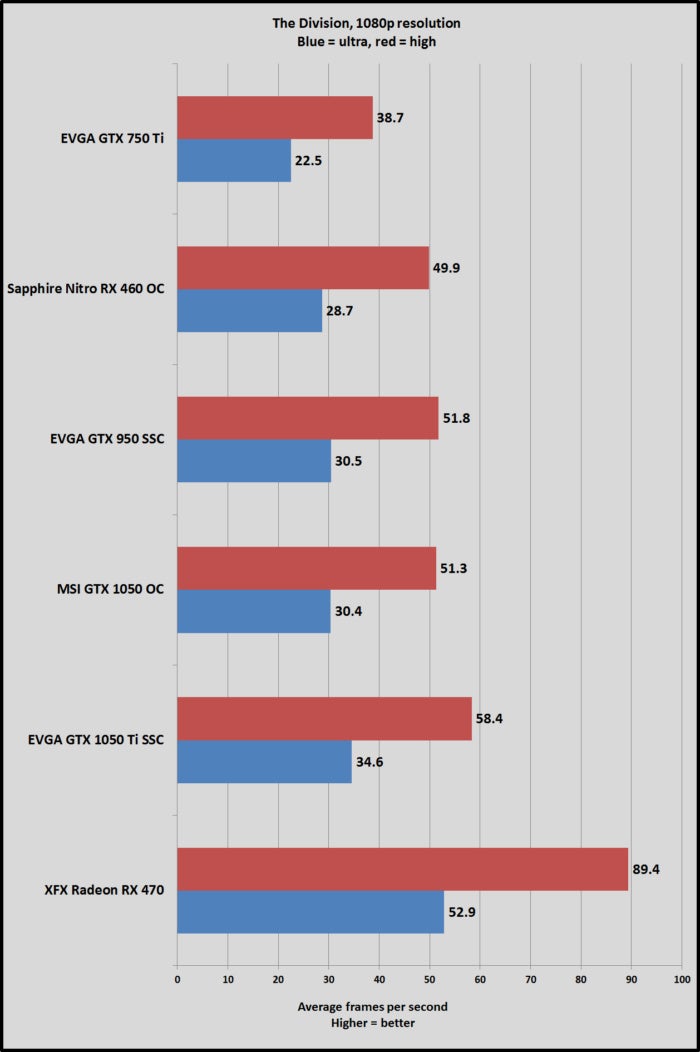
The GTX 1050 comes out slightly ahead of the RX 460 here, while the extra horsepower inside the GTX 1050 Ti widens the gulf. Both of Nvidia's new cards clear a panel-matching thirty frames per second at Ultra graphics settings, while the GTX 1050 Ti indeed flirts with 60 fps if you driblet the eye processed down to Medium. The $110 GTX 1050 also substantially ties the older GTX 950 in the closest matchup between the 2 very evenly matched cards.
Likewise note how much of a whupping the GTX 1050 family puts on the older GTX 750 Ti, and how much of a leap in performance stepping up to a $180 to $200 Radeon RX 470 offers. You'll meet like results in every game tested.
Next page: Hitman
Test two: Hitman
Hitman's Glacier engine heavily favors AMD hardware. It'southward no surprise;Hitman'due south a flagship AMD Gaming Evolved title, complete with a DirectX 12 way that was patched in later the game'due south launch.
Important note:Hitmanautomatically caps the game's Shadow Maps and Shadow Resolution to medium, and Texture Quality to low, on cards with less than 4GB of onboard memory. Because our sampling represents a mix of 2GB and 4GB cards, nosotros tested at Medium settings with Texture Quality prepare to low in both DX11 and DX12. The 4GB cards tested here could heave image quality beyond the board in this game.
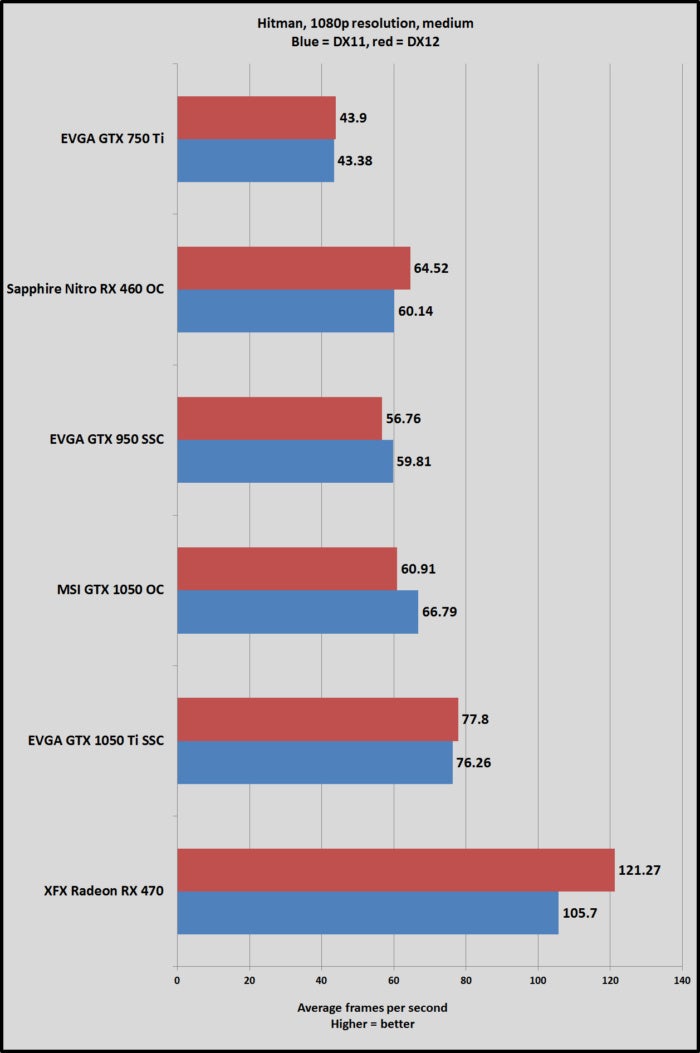
The 2GB GTX 1050 sees performance dip in DirectX 12, but that's common in 2GB cards. Comparison the Radeon RX 460 and GTX 1050's best results (DX12 and DX11, respectively) shows Nvidia'due south carte holding a slight performance advantage. In one case again, Nvidia'southward new upkeep card barely beats out the last-gen GTX 950.
The $140 EVGA GTX 1050 Ti holds a commanding lead over the 4GB Sapphire Nitro RX 460 OC, even though it costs the same and Hitman is an AMD Gaming Evolved title. This isn't shaping up well for the 4GB Radeon RX 460 at all.
Next page: Rise of the Tomb Raider
Test 3: Ascent of the Tomb Raider
WhereasHitmanadores Radeon GPUs,Ascent of the Tomb Raiderperforms much ameliorate on GeForce cards. It's also the single most drop-dead gorgeous PC game I've ever laid my eyes on. We simply test the game's DirectX 11 manner.
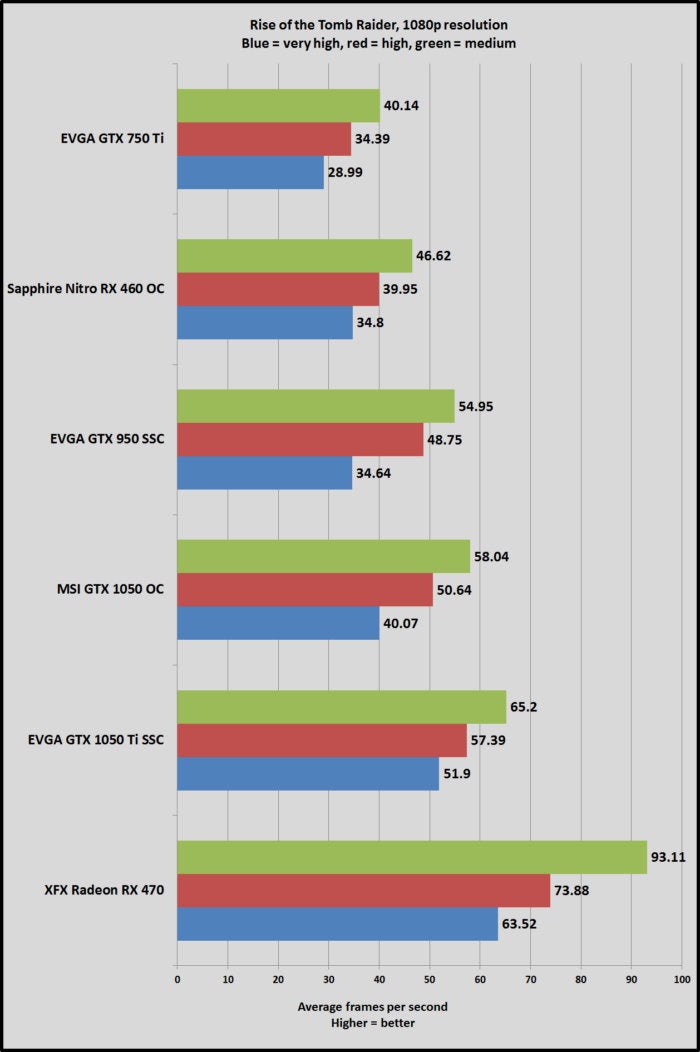
While the GTX 1050 cards were able to overcome Hitman's Radeon focus to evangelize a win over the RX 460, Team Red failed to pull off a like upset in this GeForce-axial game. The GTX 1050 pummels the 4GB RX 460, and the GTX 1050 Ti outright embarrasses it past most 20 frames per second, even though the Sapphire card packed an extra half-dozen-pin power connexion. Nvidia'due south new cards also thoroughly outpace the older GTX 750 Ti.
Next page: Far Cry Key
Examination 4: Far Cry Primal
Far Weep Keyis yet another Ubisoft game, merely it's powered by a dissimilar engine than The Partition—the latest version of the long-running and well-respected Dunia engine.
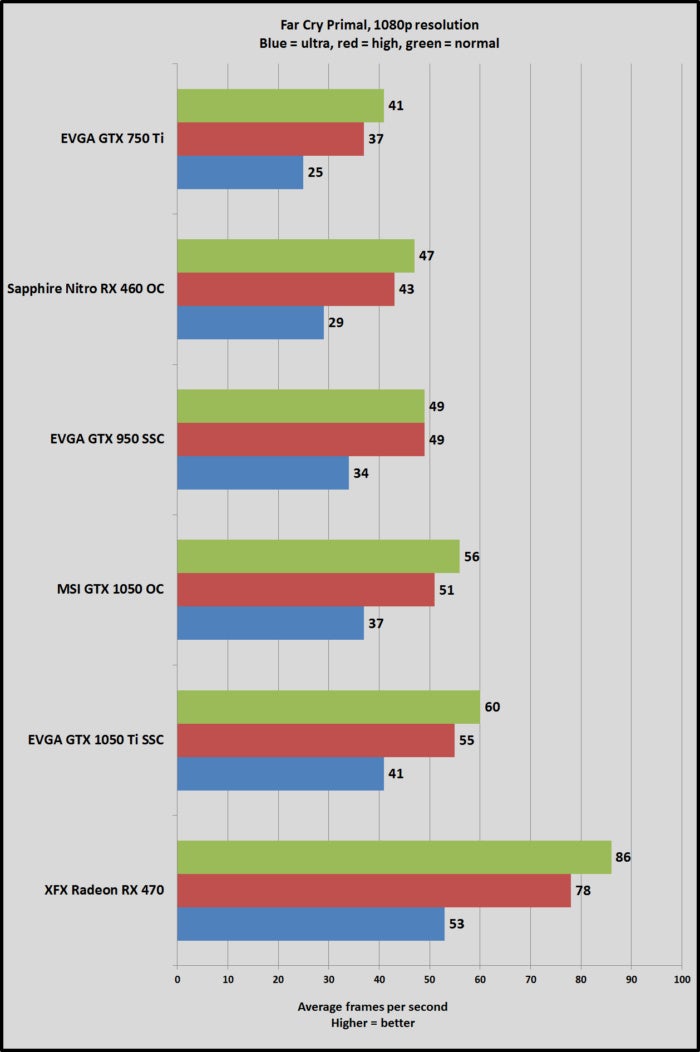
The gap shrinks a chip here, simply Nvidia's GTX 1050 and GTX 1050 Ti all the same maintain a brisk advantage over AMD'south loftier-terminate Radeon RX 460 offering. Perhaps more noteworthy, the $110 GTX 1050 and $140 GTX 1050 Ti draw troublingly close in performance, with a mere 4 fps between them.
Next folio: Ashes of the Singularity
Test v: Ashes of the Singularity
Ashes of the Singularity, running on Oxide'due south custom Nitrous engine, was an early standard-bearer for DirectX 12, and many months later it'southwardstill the premier game for seeing what next-gen graphics technologies have to offer. (It'southward a fun real-time strategy game, also!) The functioning gains it offers with DX12 over DX11 are centre-opening on Radeon cards—at least more than stiff ones.
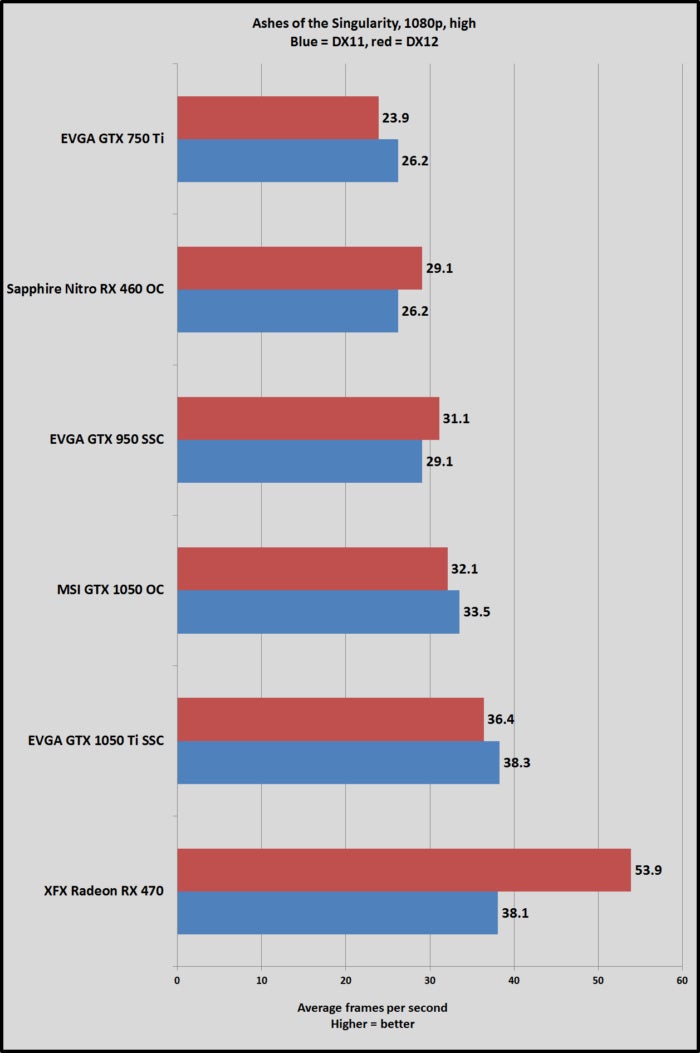
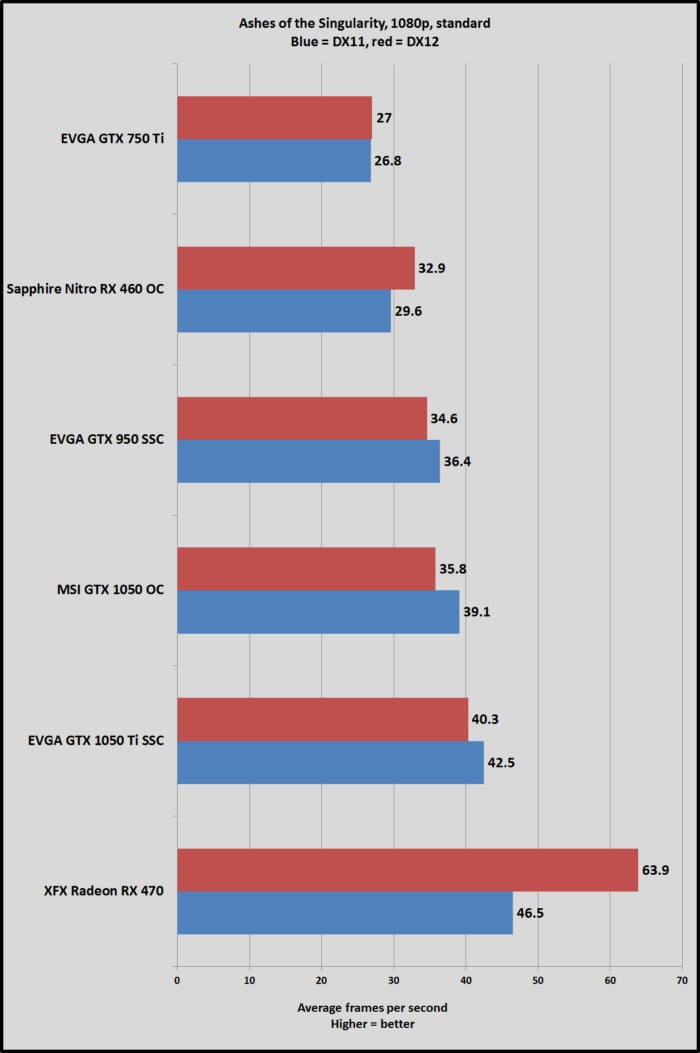
That advantage is mostly nullified at this budget-friendly price signal. In one case over again, even the $110 GTX 1050 trounces the $140 Radeon RX 460 4GB in sheer performance, while the similarly priced EVGA GTX 1050 Ti leads by roughly 10 fps—a relative chasm when we're talking about overall frame rates in the 30fps to 40fps range. In one case again, Nvidia'due south new carte embarrasses the Radeon RX 460 fifty-fifty in a game that leans heavily towards AMD cards.
All of the entry-level graphics cards struggle to clear 40 frames per second, much less 60fps. Fortunately, that matters less in slower-paced RTS games like this.
Next folio: Gears of War 4
Exam 6: Gears of State of war 4
As the newest entry to our testing suite, the DirectX 12-exclusive Gears of War four scales superbly beyond all types of hardware. Its DX12 implementation is more vendor-agnostic than Hitman and Ashes of the Singularity'southward, both of which heavily favor AMD.
We examination Gears four with asynchronous compute enabled on supported graphics boards (GTX x-series, all modernistic Radeon cards), just with Tiled Resources disabled. Tiled Resources automatically arrange texture quality on the wing to ensure the game doesn't use more memory than is available onboard your graphics card; it's stellar engineering when you're actually playing the game, but introduces unwanted, uncontrollable variance during benchmarking.
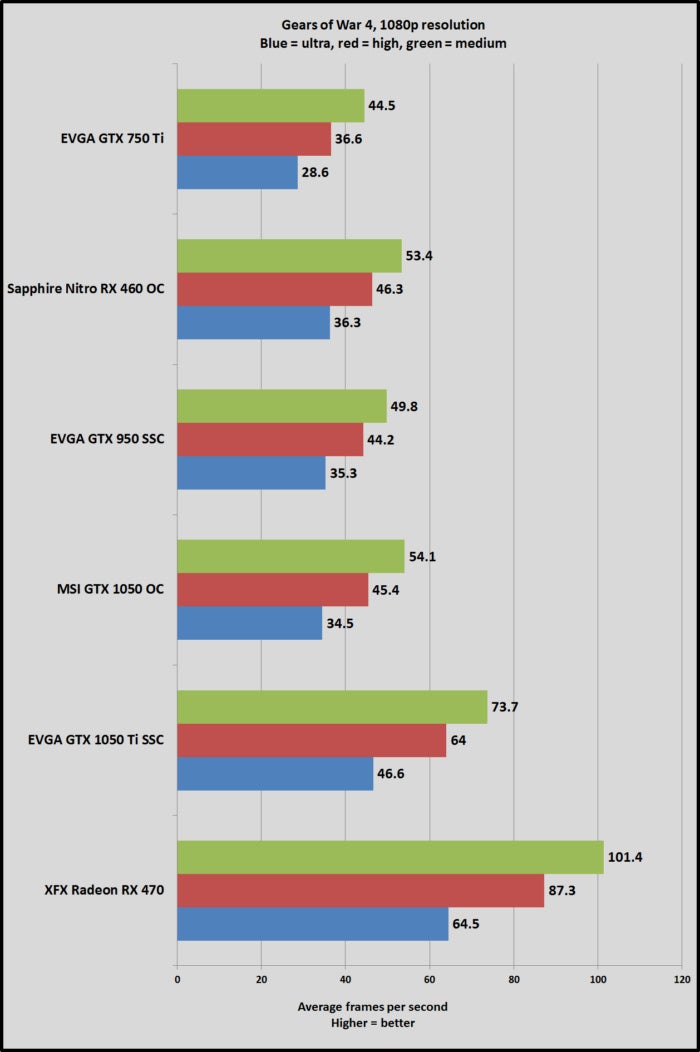
The game uses more than 2GB of retention at Loftier and Ultra settings, which partially explains why the 2GB GTX 1050 underperforms the 4GB Radeon RX 460 in every test except at Medium graphics, where that advantage is eliminated. (Exceeding card memory causes the game to tap into slower system memory, though the frame charge per unit plunges when Gears does so aren't onerous.)
Again, the EVGA GTX 1050 Ti reigns supreme amidst these budget-price cards; the XFX Radeon RX 470 provides a big jump in operation, simply costs 46.v percent more than.
Next page: 3DMark
Test seven: Constructed benchmarks
We too tested the GeForce cards and their rivals using 3DMark'southward highly respected DX11 Burn down Strike constructed benchmark, which runs at 1080p, equally well as its brand-new Fourth dimension Spy benchmark, which tests DirectX 12 performance at 2560×1440 resolution.
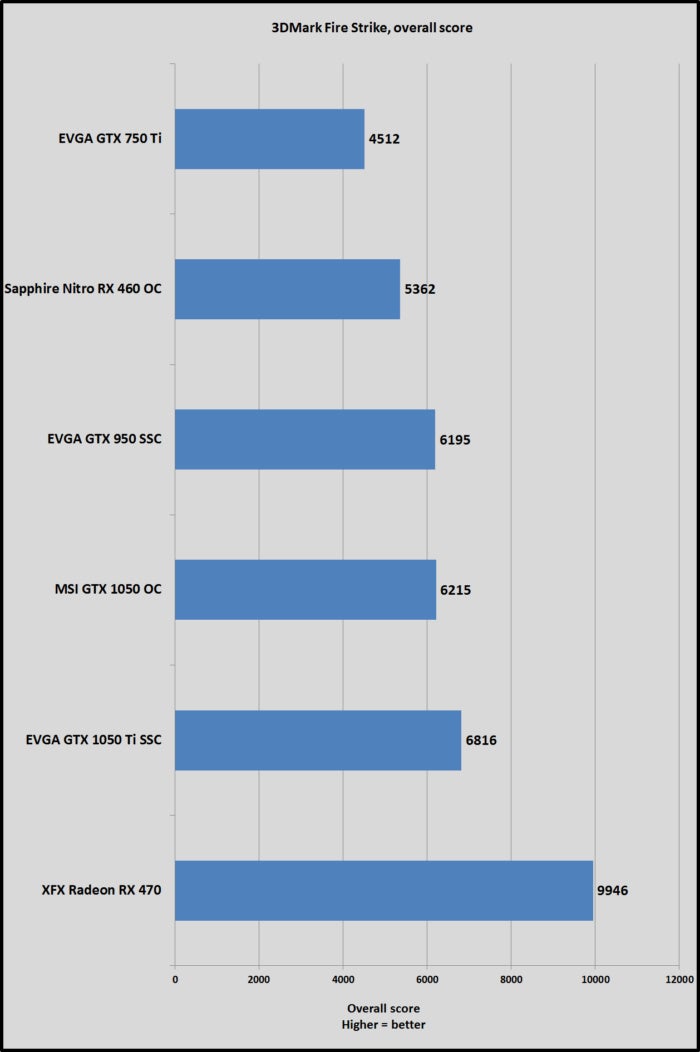
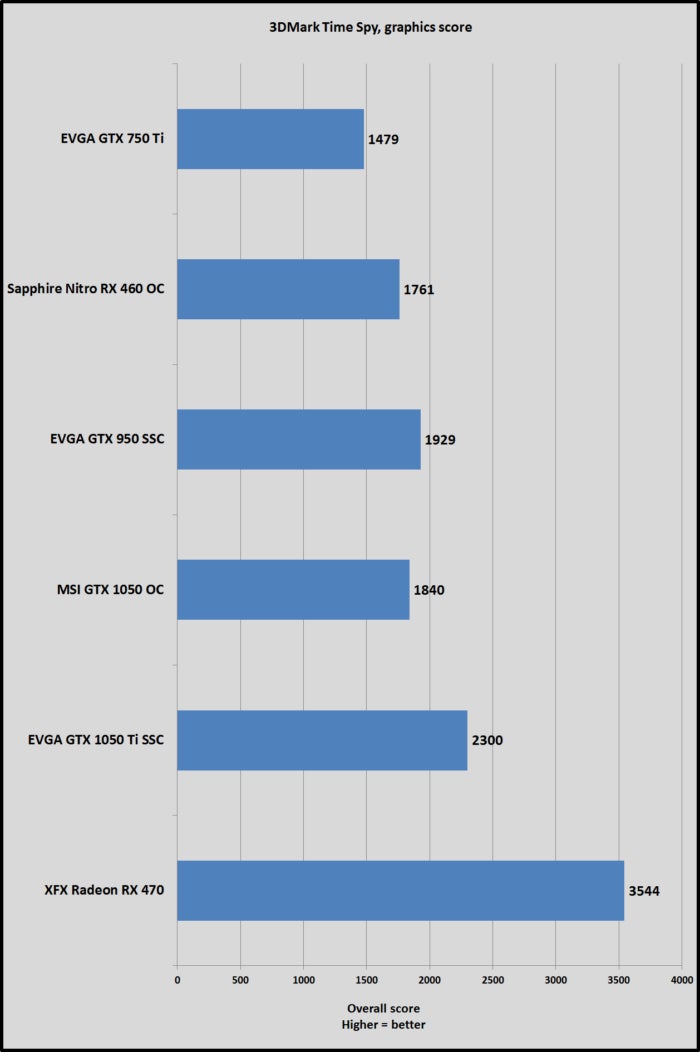
Everything falls about where you'd wait based on prior performance results.
Next folio: Ability and heat
Test viii: Power
Nosotros test ability under load by plugging the entire system into a Watts Up meter, running the intensiveSectionalisation criterion at 4K resolution, and noting the superlative power depict. Idle power is measured after sitting on the Windows desktop for three minutes with no extra programs or processes running.
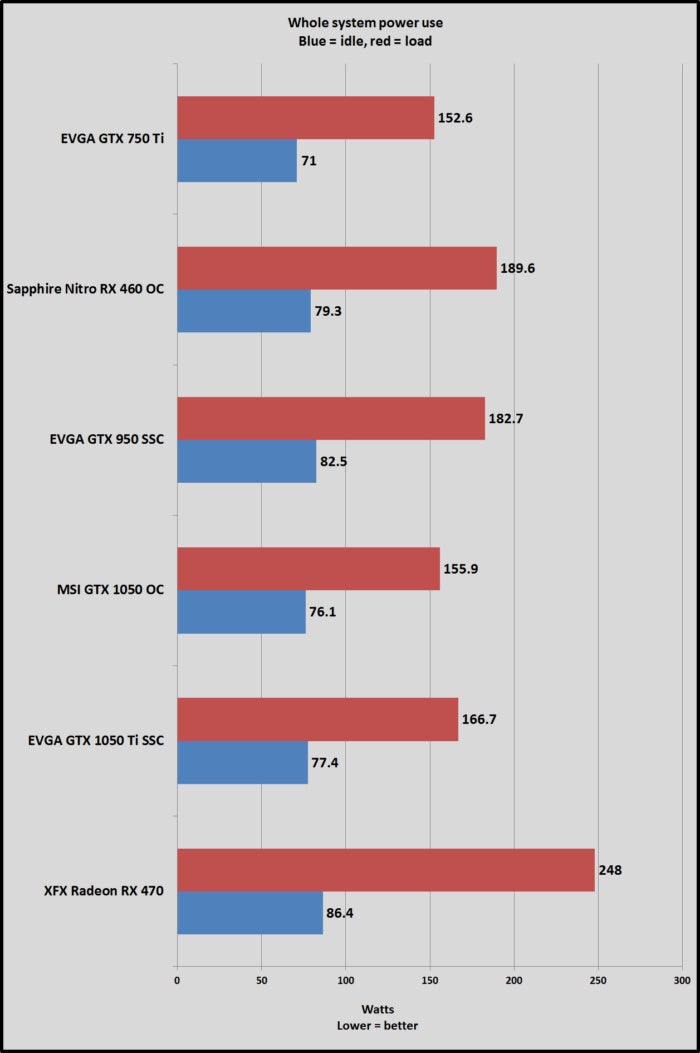
The GTX 1050 proves just as power-efficient as its legendary predecessor despite its big operation bound, while even the GTX 1050 Ti and its huge performance advantage sips nearly 20 watts less than the Sapphire Nitro RX 460 OC. That's non entirely surprising considering the latter requires a supplemental half dozen-pin power connector… only it illustrates that Nvidia however holds a commanding power-efficiency atomic number 82 over AMD'southward Polaris GPUs, fifty-fifty using a new 14nm process for this particular chip.
Examination 9: Heat
We test oestrus during the same intensivePartition benchmark, by running SpeedFan in the background and noting the maximum GPU temperature once the run is over. Beingness single-fan solutions, both the MSI GTX 1050 OC and the EVGA HTX 1050 Ti SC Gaming ran quietly even under load.
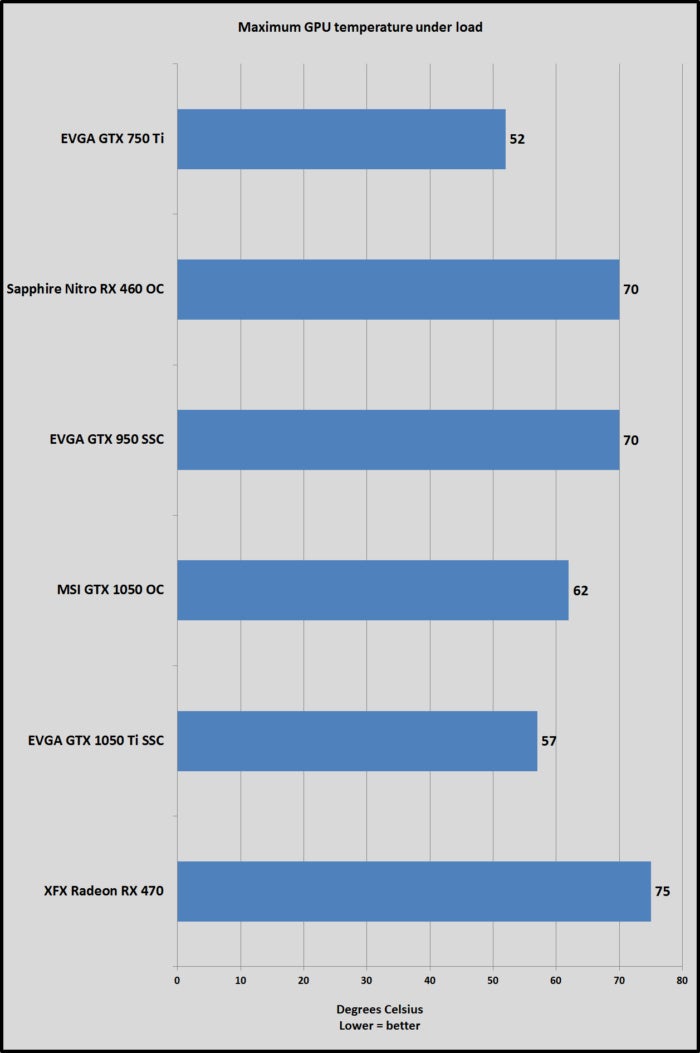
EVGA's ACX cooling solution can work magic, even in the older ACX 2.0 version plant in the company's GTX 1050 Ti. The card stays a full 5 degrees Celsius cooler than the lesser-powered MSI GTX 1050, and both unmarried-fan GTX 1050 cards stay significantly cooler than the dual-fan Sapphire Nitro RX 460 OC. In fact, only a single air-cooled card in all of our accumulated test results (beyond even what you run across here) stays frostier than the GTX 1050 and GTX 1050 Ti: Their own predecessor, the GTX 750 Ti.
Next page: Bottom line
Bottom line
Nvidia truly knocked it out of the park with the GeForce GTX 1050 and GTX 1050 Ti. Not just are these graphics cards a worthy successor (and worthwhile upgrade) for the legendary GTX 750 Ti, Nvidia'due south cards are notably libation, notably more power-efficient, and notably more powerful than AMD'due south Radeon RX 460.
Heck, fifty-fifty the $110 MSI GTX 1050 OC outpunches the $140 4GB Sapphire Nitro RX 460 OC by an average of 11.69 percent at Medium graphics, split up between minor wins in half the games and apartment-out embarrassing victories in the other one-half. The $140 EVGA GTX 1050 Ti SC Gaming—which is the same toll as the 4GB RX 460 we tested—widens the gulf even further to a whopping 28.72 percent boilerplate performance advantage. And the GeForce cards manage that domination without the help of an additional power connector, unlike the 4GB Radeon RX 460, which means that Nvidia'southward cards tin indeed slip effortlessly into prebuilt big box PCs.
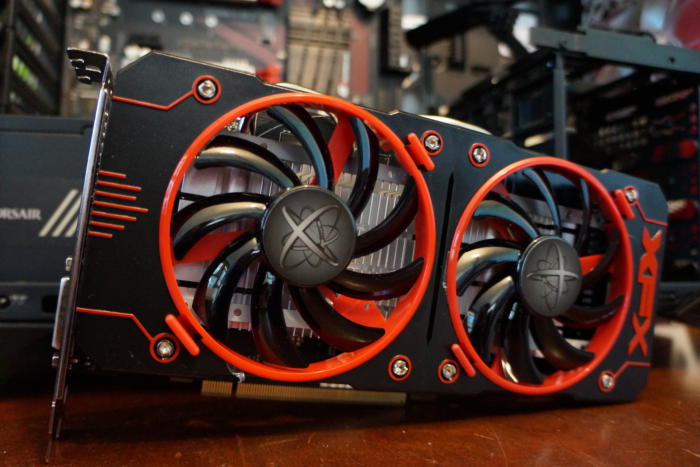
Versus Radeon
It'due south non quite R.I.P. Radeon RX 460, just it's damned close.
 Brad Chacos
 There's lilliputian reason to buy a Radeon RX 460 over Nvidia's new GeForce GTX 1050 and GTX 1050 Ti.
The GeForce GTX 1050 family wipes the floor with AMD's entry-level card in every traditional gaming metric, merely AMD's cards still concord a major advantage when it comes to budget gaming: FreeSync monitors. FreeSync monitor are significantly cheaper than Thousand-Sync monitors, starting at around $130 on Amazon for a bones 1080p display with a supported FreeSync range of 47Hz to 75Hz, and the gameplay-smoothing, tear- and stutter-killing joy of a variable refresh rate monitor tin can't exist overstated. If you program on ownership a variable refresh rate monitor to pair with your new graphics menu, a Radeon RX 460 and FreeSync display combination could be enticing, especially if you programme to stick with Radeon cards for the long haul.
But I'd recommend buying a GTX 1050 Ti and relying on its nearly 30 percent average performance advantage over the RX 460 and a FreeSync brandish in the vast majority of circumstances.
Some other Radeon advantage: If y'all programme to slap a 2d card into your organization at some point in the hereafter, the Radeon RX 460 would be your only choice, as the GTX 1050 lacks SLI support. Most people who buy graphics cards in this price range would exist better off investing in higher performance today rather than accepting lower functioning with an eye toward the future, specially if y'all're slapping a sub-$150 graphics menu into a prebuilt computer. Most "big box" PCs don't include extra PCI-E slots anyway.
AMD'south price cut for the Radeon RX 470 makes things interesting, every bit information technology offers far superior performance to Nvidia'due south new cards. At its new $170 "suggested e-tail price" (SEP), an RX 470 would just cost $30 more than a GTX 1050 Ti. Only exist wary: The vast bulk of RX 470 cards still sell for $185 or up on Newegg (a 33-fpercent premium over the GTX 1050 Ti), and the cheapest ones accuse you for shipping. More crucially, the Radeon RX 470 demands the utilise of a 6-pin power connector, which nullifies its potential for upgrading a "large box" figurer into a gaming rig. It also draws significantly more than free energy than the GTX 1050 and Radeon RX 460 through that connector, and throws off much more rut under load.
The Radeon RX 470 will rock your gaming socks if you take both the upkeep and the PC for information technology, but information technology's a totally different grade of card than the entry level GTX 1050 lineup.
Versus Nvidia
Brad Chacos Nvidia isn't only competing with AMD though—it'southward also competing with older GeForce cards. The $110 GTX 1050 outperforms the older GTX 750 Ti past an average of 34.44 percent across our games suite at Medium graphics, hitting at to the lowest degree 50 frames per second in everything only Ashes of the Singularity. Information technology's a worthwhile upgrade. The $140 GTX 1050 Ti beats last-gen's more stiff GTX 950 past an average of 25.95 percentage—a minor, but still sizeable bound made all the more impressive because the GTX 1050 Ti is powered wholly through your motherboard.
Snag the GTX 1050 if you'll stick to e-sports or less intensive games at Medium settings, but if you plan on belongings onto the carte for a few years, I'd suggest spending extra on a GTX 1050 Ti and its more future-proof 4GB of RAM. The GTX 1050 Ti besides lets you lot striking roughly 60 fps with far more consistency than its lesser-powered sibling, likewise as sneak in some college-quality graphics settings. If you don't mind panel-similar frame rates, both of these cards clear 30 fps even at Ultra settings. Finally, between the carte du jour's superb ability characteristics and support for HDR, 4K over HDMI, and more, these cards should be killer options for home theater PCs.
Lesser line: The MSI GTX 1050 OC and EVGA GTX 1050 Ti SC Gaming both kick ass. They're hands-down the best graphics cards options in the $100 to $150 cost range. There's no need to upgrade to either from a GTX 950, but if you're moving up from an older-generation GPU, or simply want to plough a non-gaming PC into a gaming PC with minimal hassle, the GeForce GTX 1050 and GTX 1050 Ti come highly recommended.
Annotation: When you buy something later clicking links in our articles, we may earn a small commission. Read our affiliate link policy for more details.
vincentknines1992.blogspot.com
Source: https://www.pcworld.com/article/410793/nvidia-geforce-gtx-1050-and-gtx-1050-ti-review-the-new-budget-gaming-champions.html
0 Response to "Msi Geforce Gtx 1050 Ti Directx 12 Gtx 1050 Review"
Post a Comment