Peter Garrett I d Do It Again Peter Garrett
I n the nascent Sydney punk scene of 1976, the Oxford Funhouse on Taylor Square was ground zip. The venue had been established by Radio Birdman who, forth with Brisbane'due south the Saints, tin can lay claim to the title of Australia'south commencement punk band.
Peter Garrett, who was leading an embryonic ring not yet named Midnight Oil at the time, checked them out early on and came abroad a changed human being, marvelling at how the hipsters in the oversupply kept their sunglasses on among the mayhem. "The sound was light amplification by stimulated emission of radiation-bright and ferocious, and frontman Rob Younger was riveting, stalking the tiny stage with a leonine fury," he wrote in his memoir, Big Blue Sky, released late concluding year.
If you want an thought of where Garrett got the unique dance pace that captivated audiences for over twenty years, watch Younger in action. Garrett wasn't informed by his movements so much as the idea of performance as an altered grade of consciousness. "I like to become myself into a state where I'm not enlightened of what I do at all, however somehow I get it all out," Younger said at the fourth dimension. "I don't know, I attempt not to call back about information technology."
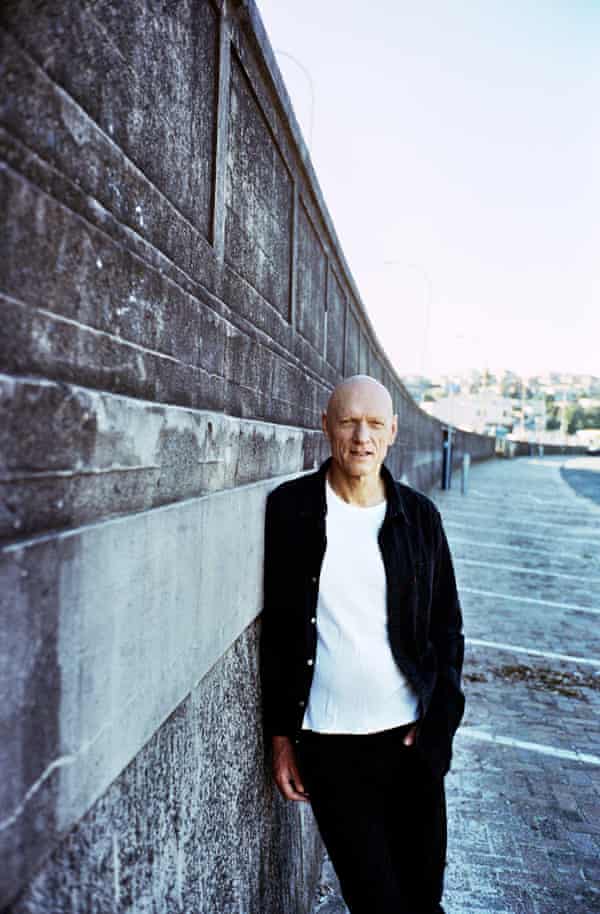
Garrett similarly deflects questions about his dancing, equally if talking about it might cause him to freeze. "You're suspending rational thought, as yous should when y'all become into that zone," he says. "When you lot start to move and feel the free energy around you, if y'all retrieve well-nigh information technology for i 2nd you become a clichéd plastic statue. Which we'll try to avoid for a little bit longer."
Garrett – as he proclaimed on Tall Trees, the start song and single from his first solo album, A Version of Now – is back, and he remains a man of formidable energy. If his 63 years take slowed him somewhat, he won't be just treading the boards on an upcoming promotional tour, either. Later in the year Midnight Oil will reconvene, with the band planning to spend much of 2022 on the road. Again.
At that place are two public sides to Garrett: the whirling dervish on stage, and the highly organised figure who, years before he left Midnight Oil to join the Labor political party, served his first term equally president of the Australian Conservation Foundation betwixt 1989 and 1993, at the pinnacle of the ring's success. He then served a further two years on the international board of Greenpeace.
"They're both the aforementioned person," Garrett says, lounging in a community café in Redfern, where he's merely done an interview for Koori Radio. As distinctive as ever, he doesn't escape without shy requests for selfies and signatures. "You might discover dissimilar sides of the same person when you go on holidays with them, or sitting around a campfire, or if yous have a big dark in a karaoke bar."
Garrett is used to being reduced to a caricature. Then was his ring. "[Midnight Oil was] misunderstood in terms of being seen as specifically constructed to deliver a political philosophy," he says. "Misunderstood in being seen every bit very blokey and pub-ish, which nosotros weren't at all, certainly not as people. Misunderstood overseas, because no ane knew where the hell Commonwealth of australia was, or what nosotros were writing about."
That didn't terminate Beds Are Burning – a pointed call to white Australia to return the land to its original inhabitants – from becoming the band's biggest hit in America. All the same, in that location was ever more than to Midnight Oil than slogans. "I idea there was some brainchild in what we were doing," Garrett says, before conceding: "Probably not a lot of humour, it'southward fair to say. Non my potent suit. Humour ain't Oils!"
A Version of Now isn't played for laughs either but it'southward oftentimes unexpectedly tender and sweet. There are honey songs to Doris, his wife of thirty years, which are equally direct as anything he's ever written. Their three daughters, Emily, May and Grace, sing harmonies; May even plays drums on ane track.
And while it features the Oils guitarist Martin Rotsey, it sounds like a genuinely personal solo project. There was no thought of bringing the songs to rest of the group, he says: "They came and so chop-chop and then I knuckled downward and tried to knock them into shape and go people to play them equally apace every bit I could. They sounded like Peter Garrett songs."
What it does share with his old band is some of the rawness that marked their early records. The arroyo was basic: "We're in a room, we've learned the chords – or perhaps we haven't quite learned them – and we're going to grab the moment." The album was produced past Burke Reid, who has worked with the Drones and Courtney Barnett. Garrett was inspired by the unvarnished sound of both.
"The Courtney record [Sometimes I Sit down And Think, Sometimes I Just Recollect] was like being on a skateboard, rolling down a loma – 'This is what I am, this is what I sound similar, this is what I talk nigh'," he says. "It had a spirit of music that I honey that is timeless in some means, because it was so gritty, real and without pretension."
People often inquire who dares to talk about large issues in pop music these days and it hasn't escaped Garrett that the Drones and Barnett are among them. "At that place'southward plenty of it out at that place [and] I was interested in what they had to say simply I also liked the sound." The music, he insists, always comes beginning. "If it doesn't accept that internal combustion, you've got zilch."
None of which ways that Garrett has nix to say. I'd Do It Once more, the anthology's second song, should stay a thousand journalists' questions: "I didn't leap, I wasn't pushed / I went on my own, I've got to practise what I could / I got my hands dirty and had a go". Garrett's rejection of the purity of activism for the messy compromises of high office remains unapologetic.
But those words "I'chiliad back" likewise advise he's aught if not happy to be making music again. "And who wouldn't be, really? It'due south not that I wasn't happy with what I was doing but they're very dissimilar kinds of vocations and in that location'due south not a lot of blend. I gauge my starting indicate is that I recollect we can have a go at more than 1 kind of affair and many people do."
He concedes he "sometimes" felt like an outsider in politics, and in the Labor party too, partially because he wasn't part of any faction. Only neither was he a career politico. "The fact of the matter is, and most politicians would recognise it, that to some extent the lives that they've lived prior to inbound the parliament are quite narrow."
The issue, he says, is an entrenching of the political classes, in which he includes advisers, lobbyists and various apparatchiks and insiders, including the press gallery. "The ultimate result of that confection is that information technology's very difficult to intermission out from stasis or antipathy and the never-ending striving for brusque-term political advantage."
After the 2010 election, he remembers, suddenly "there was a row of younger, seriously hardline rightwing climate sceptics sitting on the other side of the parliament. It makes you suspension for a second to recall and information technology also makes y'all need of someone like the current prime government minister [Malcolm Turnbull] that they do live up to their convictions."

But the intractability of issues such equally refugee policy, for example – which Garrett admits was "deeply, deeply challenging" – oft meant personal convictions came a distant concluding in the same political machinery he has just described. Function of our disenchantment, he says, is driven by a skewed view of what politics can realistically deliver. And when it doesn't, "there's no shortage of people howling it downwardly".
No one, at least, could charge Garrett of non having experienced life before entering politics. Two high points he names from Midnight Oil's career were playing the get-go multiracial concert in South Africa in 1994, following the ballot of Nelson Mandela as president, to roughly eighty,000 people in Ellis Park, Johannesburg; and playing Beds Are Burning at the closing anniversary of the Sydney Olympics in 2000, with the band wearing "Sorry" suits.
That – like the band playing on a flatbed truck outside the Exxon edifice in Manhattan in 1990, in a guerrilla-mode protestation later the Exxon-Valdez oil spill the previous year – was essentially a prank but it was too extremely effective political theatre. And very punk. "Information technology was agitprop," Garrett says. At such times, "nosotros felt we were part of something bigger that was at play".
Whether the ring will enter the studio again remains to be seen. "I think [the band members] obviously are withal artistic, [we'd] like to be creative. You've got to exercise it for the right reasons." He notes the band's contemporaries Cold Chisel have had a second life, "and they've fabricated a off-white fist of it. It's been skillful, the stuff that they've done, I've enjoyed it.
"There's no reason why non. We're not spring temporally; we're only bound by how fearful, how brave, how imaginative, how hard we're prepared to piece of work, and I call back if we continue to bring the love of music and making music together so peradventure we'll see something come out the other finish. Whatever information technology is you exercise, if it'south still moving yous, then effort to do as much of it as possible, earlier it's too late."
But, ever, it's the alive shows that will come commencement. Midnight Oil became effective users of the studio equally an instrument – particularly on their 1982 quantum anthology, x,ix,eight,7,6,v,four,iii,2,1. But the studio is a bit like the parliament: sounds are negotiated, compromised and brokered. It's on stage, in front of an audience, where Midnight Oil fabricated its reputation.
Garrett's upcoming solo tour volition give him the chance to splay his easily and wave those long arms around over again, in those inimitable jerky movements that somehow piece of work with the jagged angles of the music. Merely really, it'south a prelude to the principal act next year, when the Midnight Oil juggernaut rolls back into activity. Information technology's also a test. Can they do it once again, or will they be, in Garrett'due south words, clichéd plastic statues?
"It'south non similar we can go out every nighttime, [whether] it's a club show or a theatre testify, and only switch it," he says. "We've got to suck the music out of the marrow of our bones and spit it back out over people, with all the sense of no tomorrow that nosotros can muster upward."
Peter Garrett'southward solo anthology A Version of Now is out now; Peter Garrett & the Alter Egos' national album tour begins in Perth on 21 July; Midnight Oil's reunion tour will have identify in 2017
vincentknines1992.blogspot.com
Source: https://www.theguardian.com/australia-news/2016/jul/17/midnight-oil-frontman-peter-garrett-is-back-and-hes-ready-to-dance-again
0 Response to "Peter Garrett I d Do It Again Peter Garrett"
Post a Comment